The Right to Choose

You might think I’m talking about pro choice, and I am, and will get the to the more familiar use eventually .
My father was born in Marlboro County, South Carolina in 1926.
By the time he became a man, the 15th Amendment to the United States Constitution had already been law for more than half a century. On paper, he had the right to vote. The Constitution said so.
Reality said something else.
By 1947, living in North Carolina, he was old enough to vote, but he couldn’t read. And in the South at that time, that wasn’t just a personal limitation, it was a political barrier. Literacy tests weren’t designed to measure knowledge. They were designed to deny access. Registrars could decide who passed and who didn’t, and for Black men like my father, the outcome was always the same.
The right existed, tenuously in the South. Access did not.
In 1953, he moved north to Illinois as part of the Great Migration. People talk about jobs when they talk about The Great Migration, but there was something else on the other side, something just as important. The possibility of participation. The North wasn’t free of racism, but it did not carry the same machinery of voter suppression at the courthouse door. I can’t say for certain whether my father ever registered to vote, but I know the difference between where he came from and where he arrived.
One system was built to stop you. The other, at least in comparison, allowed you through.
What was written into law in 1870 did not slowly become reality. It was resisted. Actively. Violently. For nearly a century.
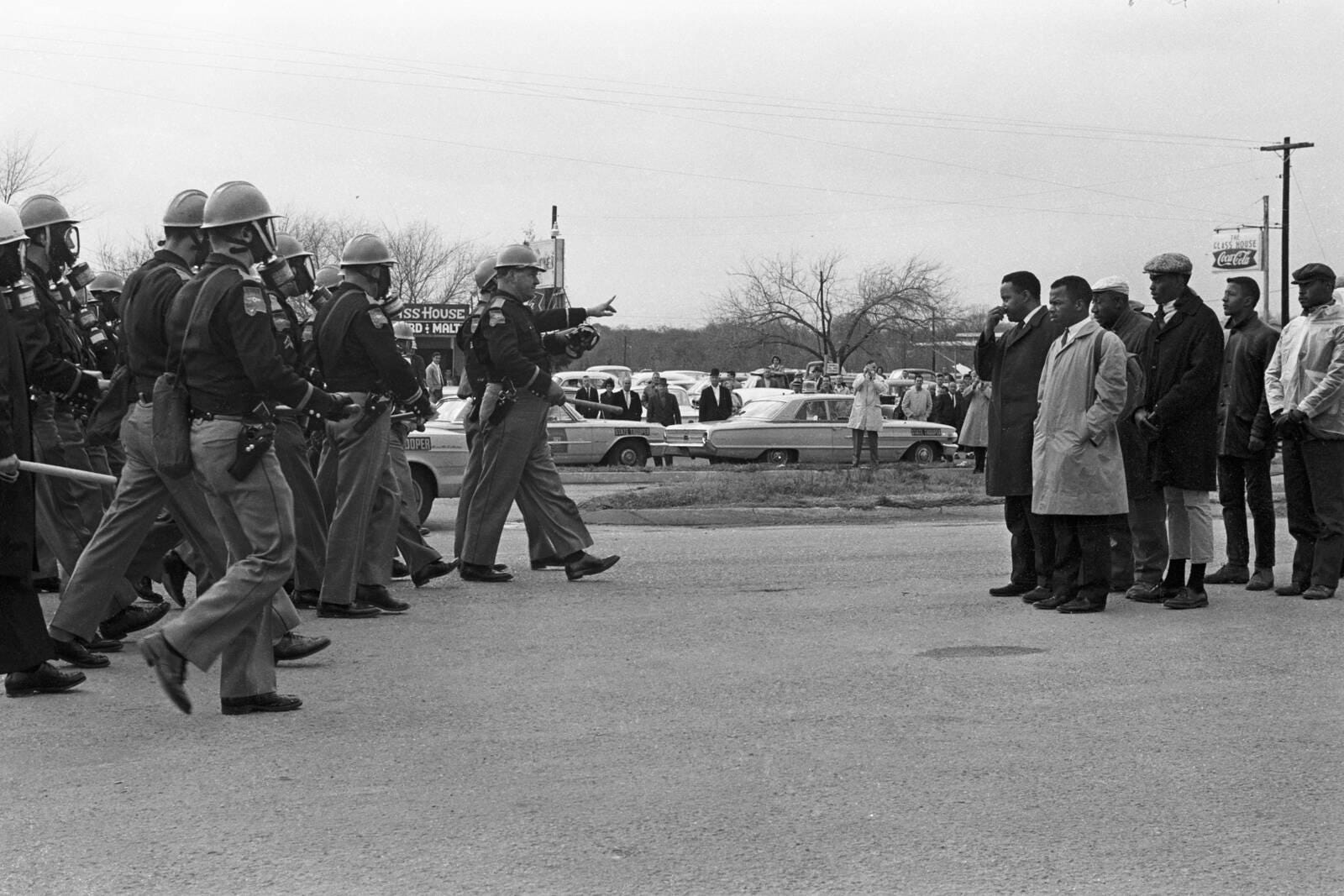
The Voting Rights Act of 1965 was not the product of a system correcting itself. It was the result of people forcing that system to confront what it was doing. People marched knowing they would be beaten. They registered knowing they could lose their jobs, their homes, or their lives. They crossed bridges knowing what waited on the other side.
On March 7, 1965, on the Edmund Pettus Bridge in Selma, Alabama, that resistance was met with state-sanctioned violence. Bloody Sunday was not the exception. It was the system revealing itself.
The difference that day was not the violence. The difference was that the country was made to see it. America did not wake up and decide to do the right thing.
It was pushed. It was exposed. And it was left with no choice but to respond.
The Voting Rights Act was not a gift.
It was a concession and the majority of America has actively wanted to repeal since it was added to the Constitution.
Section 2 made something clear. It wasn’t enough to look at what a law said. You had to look at what it did. If a system produced unequal outcomes, if it diluted the power of Black voters, it could be challenged.
Because the tactics had changed.
No more signs that said, “You can’t vote.”
Now it was lines drawn on maps.
Polling places moved.
Rules rewritten.
Nothing said race.
Lee Atwater told them – you can’t say n-word, n-word, n-word any more it hurts you.
Everything produced the same result.
Section 2 gave people a way to fight that.
Then the Court began to move.
In Shelby County v. Holder, the Supreme Court removed preclearance, the part of the law that stopped discriminatory changes before they could take effect.
The front door was gone.
Now, in Louisiana v. Callais, the Court has gone after the back end.
In a 6–3 decision, it struck down a map designed to create a second majority-Black district, ruling that using race in that way can be unconstitutional. The message is clear. The law is shifting away from judging systems by what they produce and toward demanding proof of why they were created.
Outcomes are visible. Intent is arguable, and that difference changes everything.
States are now trapped in a contradiction.
If they do not create districts that fairly represent Black voters, they can be accused of dilution. If they do create them and race plays a role, they can now be accused of racial gerrymandering.
Fixing the problem can now be treated as the problem.
That is not a loophole.
That is a redesign.
And you didn’t have to wait to see the impact.
Almost immediately, states like Florida, under Ron DeSantis, began moving to redraw maps again.
Because when the guardrails or removed, behavior changes.
Less legal risk. More political opportunity.
This is not theory. This is power adjusting in real time.
The same people that are working hard to “gut” the VRA are the same one that successfully reversed Roe v. Wade that’s important, the choices we make and have made as a country are literally pulling us backward towards, Jim Crow, segregation, white nationalist rule, and their vision of MAGA which would have us in chains if we are not careful.
Different issues. Same direction.
Rights that were once considered settled are now being reconsidered, reinterpreted, and, in some cases, removed. The burden is shifting back onto the people to prove, again, that they deserve what was already promised.
In 1964, Malcolm X said it plainly in The Ballot or the Bullet.
“We’re all in the same boat and we all are going to catch hell from the same man. He just happens to be a white man. All of us have suffered here, in this country, political oppression at the hands of the white man, economic exploitation at the hands of the white man, and social degradation at the hands of the white man.”
Malcom told us, “If we have differences, let us differ in the closet; when we come out in front, let us not have anything to argue about until we get finished arguing with the man.”
And finally – “It isn’t that time is running out - time has run out!”
My father didn’t need the right to vote.
He already had it.
What he needed was access to it.
That’s what people bled for. That’s what they marched for. That’s what they were beaten for on a bridge in Selma so the country could no longer pretend it didn’t see.
And now, piece by piece, the mechanisms that made that access real are being weakened.
Heading toward erasure, moving to outright denial.
They are removing protections and as we know enforcement of the law depends on the color of your skin.
That’s how it happens.
The right remains.
The access begins to slip.
Until somebody decides you don’t need either anymore.
Until you lose the right to choose.
Go!❤️🩹🖤💚💛
Brick by brick some wish to dismantle what has collectively been built (although not equitably credited or compensated) in this country and attribute the whatevers’ left solely to their side.
Guess what? They’re going to fail again. They will NEVER rise.