The Playbook

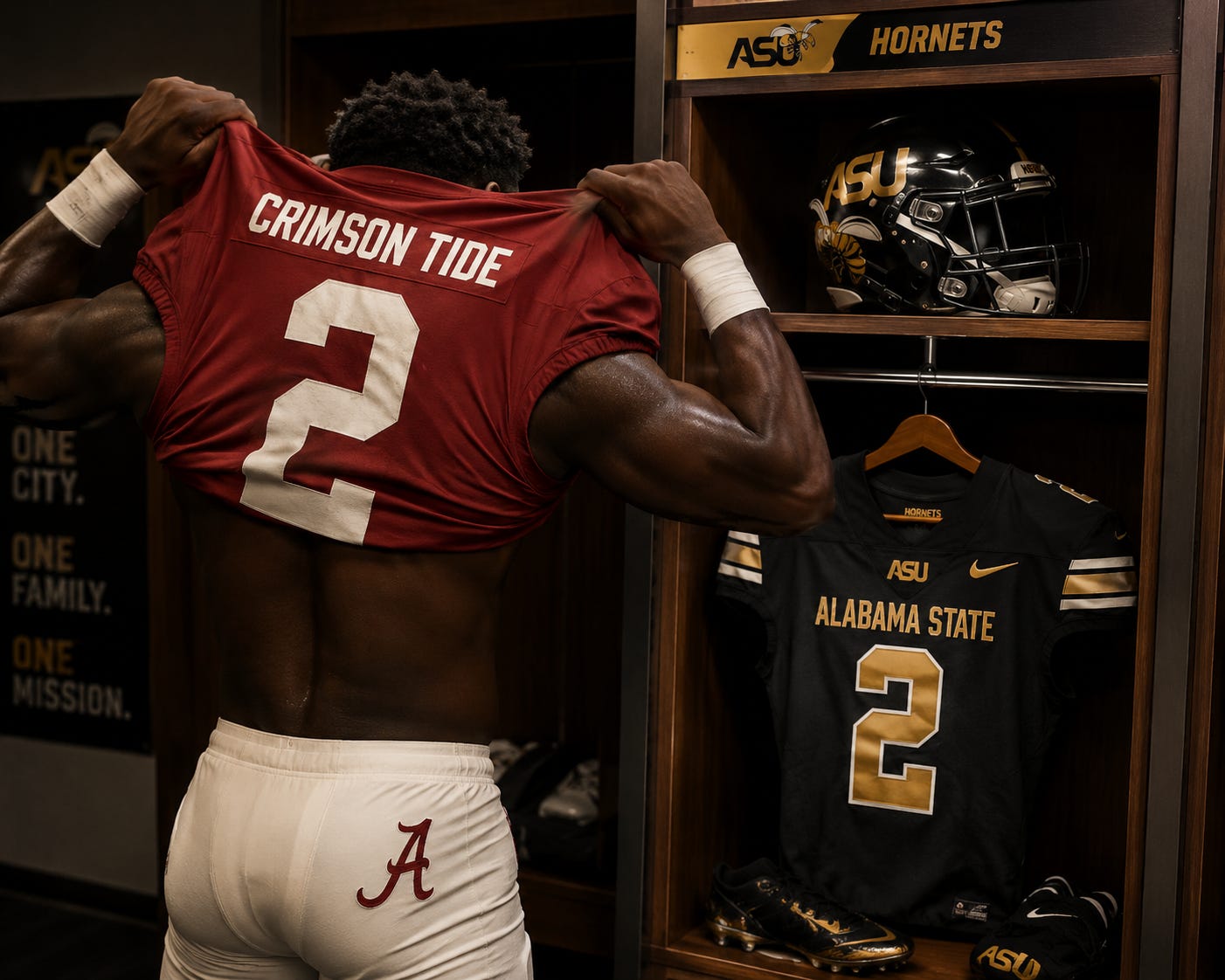
I am a football fan. I played it in high school and college, coached Jr. Wildkits football, and served as Assistant Director. I also know this, and it may offend the sensibilities of some people, but without Black players football would suck. For that matter so would basketball. The WNBA would not exist without Black women and the agency they are showing to gain equity and, more importantly, respect and power.
The University of Alabama football program generated $142.6 million in revenue in 2025, with profits reported at $64.1 million, a 43% return on revenue. The majority of the labor force producing that revenue on the field was Black.
For comparison, one of the largest Alabama slaveholders in 1860, Jerrett Brown of Sumter County, was recorded with 540 enslaved people. If a plantation that size produced roughly 1,000–1,600 bales of cotton, at about $50–$55 per bale, its annual gross revenue would have been around $50,000–$88,000 in 1860 dollars. Using simple inflation, that equals roughly $2 million–$3.5 million today. But measured by economic power, share of the economy, and wealth concentration, that same plantation revenue could represent hundreds of millions of dollars in modern economic weight. And that does not include the enslaved people themselves, who were treated as capital assets, likely valued at several hundred thousand dollars then, or tens of millions in today’s dollars by inflation alone, and far more by wealth-share comparison.
Lately I’ve found myself going back and forth between Dr. King and Malcolm X, vacillating between nonviolence and “the ballot or the bullet.” Trying to understand what resistance looks like in modern America when the rules are rewritten in plain sight. Voter suppression wrapped in “election integrity.” DEI bans wrapped in “fairness.” Black history stripped from classrooms while billion-dollar universities proudly run onto football fields behind Black labor every Saturday.
Back to Alabama.
On June 11, 1963 Governor George Wallace physically attempted to block two Black students, Vivian Malone and James Hood, from enrolling at the university. Wallace famously said in his inaugural address, “Segregation now, segregation tomorrow, segregation forever.”
This happened in my lifetime.
Which means it is highly possible that the kids taking the field for a school a former governor wanted to make sure they never entered are the grandchildren of people who could not set foot on campus.
Not 100 years ago.
Sixty-three.
Approximately 65–75% of the Crimson Tide football roster is Black.
But maybe the answer is neither the bullet nor the ballot alone.
Maybe the answer is leverage.
Economic leverage.
Cultural leverage.
Collective leverage.
And before anybody starts clutching pearls and pretending outrage, America already understands leverage. Corporations use it. Lobbyists use it. Politicians use it. Universities use it. Billionaires use it every day. The only thing radical is the idea of Black people using it collectively and strategically.
This isn’t a new thought for me. A year ago I wrote about the economic and cultural dependence America has on Black athletic labor in a piece titled Black Bodies Built the Game. At the time I asked, “What if we sat this one out?” This thought experiment feels like the next evolution of that question.
So let’s call this what it is:
A thought experiment.
What if every Black football player at Alabama entered the transfer portal at the same time?
Not quit.
Not boycotted.
Just entered the portal.
College sports would freeze.
Not slow down.
Freeze.
What would happen to the people sitting in skyboxes, the ones whose families may have stood on the same side of history as George Wallace?
The ones applauding redistricting and the elimination of Black voting power. The ones still romanticizing the Confederacy while cashing checks generated by Black labor every Saturday.
The ones that yell the n-word when a receiver drops a pass that would have been a touchdown.
What would happen if Black players transferred right down the street to Alabama State?
Would they change colors too?
We may not need a bullet or a ballot.
Maybe just a portal.