Happy Birthday Malcolm

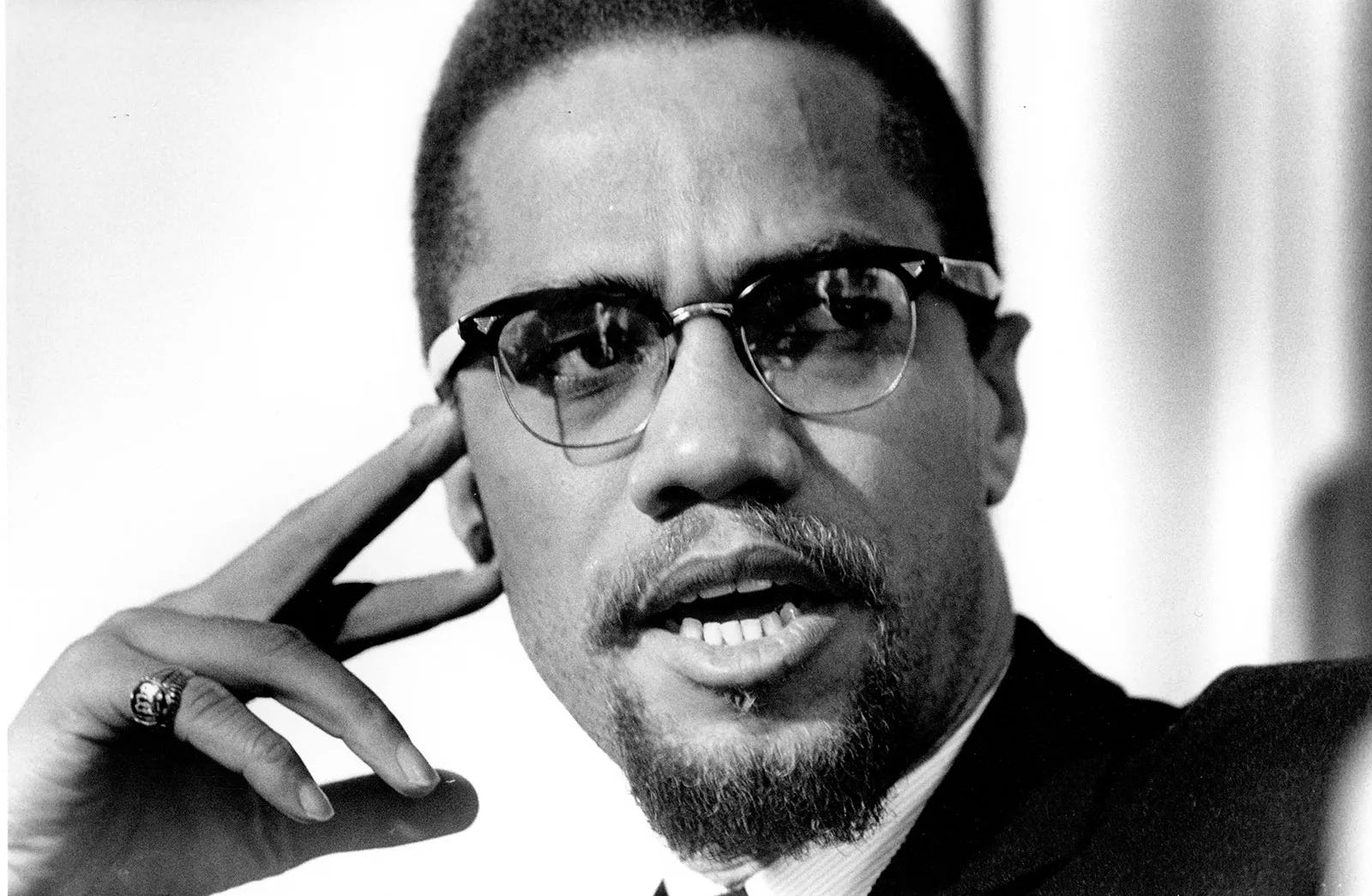
Malcolm X would have been 101 years old today. I’ve been reading a lot about Malcolm lately, his speeches, The Autobiography of Malcolm X Malcolm X: A Life of Reinvention by Manning Marable. There are many reasons for studying Malcolm, mainly because as I continue my own journey to become my full Black self, I realize there is still so much history we were never taught, even about the icons we quote and put on T-shirts. The second reason is my spiritual journey in my upcoming book, Circumventing Your Religion to Find My God(s). I spent time studying the Nation of Islam, with Malcolm as the starting point.
Recently, I was asked a question I’m sure has been asked since his and Martin Luther King Jr.’s assassinations: What if they were alive today? What would they think about America now? So I started a new project, What If They Dodged the Bullet?
Think about Malcolm’s Instagram and TikTok today, several million followers, livestreams dissecting politics, capitalism, race, religion, policing, Gaza, Haiti, education, and Black economics in real time. Malcolm always understood media. He understood messaging. More importantly, he understood power. And I think if he were alive today, much of what he would say would sound less prophetic and more painfully familiar.
Malcolm once said, “Usually when people are sad, they don’t do anything. They just cry over their condition. But when they get angry, they bring about a change.” I think Malcolm would look at modern America and ask Black people why we are constantly instructed to fear our own anger while other people weaponize theirs politically every single day. They tell us to calm down while banning books like Alex Haley’s Roots, gutting voting protections like in Louisiana and Alabama, dismantling diversity programs, and sanitizing history itself. Malcolm would remind us that every major movement for Black progress in America was born from a people who got tired of mourning quietly. Sadness fills graveyards. Organized anger changes nations.
I keep asking the question; are we angry enough yet?
He also said, “Hence I have no mercy or compassion in me for a society that will crush people, and then penalize them for not being able to stand up under the weight.” That line may describe modern America better than anything written this year. They created segregated neighborhoods, stripped wealth from Black communities, underfunded schools, over-policed streets, flooded neighborhoods with drugs, built prisons for the aftermath, then blamed the people surviving inside conditions they engineered. America has perfected the art of creating injury and then punishing the wounded for limping. Malcolm would see the same machine, just updated with better branding and Wi-Fi.
And then there is the Malcolm quote that may hit hardest today: “How can you thank a man for giving you what’s already yours? How then can you thank him for giving you only part of what is yours?” Malcolm would probably laugh at the idea that basic dignity is now debated under the label of DEI. Voting rights are not gifts. Equal education is not charity. Fair housing is not generosity. Representation without power is not freedom. Black people are still disproportionately absent from ownership, banking, media control, institutional wealth, and corporate leadership, yet America wants applause every time it grants a “First Black” award. Malcolm warned us not to confuse access with liberation. Many of us have done just that, that complacency could end up with us being in chains.
But I think the most dangerous thing Malcolm would say today is something many people still fear hearing out loud. He might lean back toward separation, not segregation imposed by white supremacy, but intentional separation rooted in self-preservation, ownership, and protection. Because Malcolm would remember Tulsa Race Massacre. He would remember Rosewood. Wilmington. Redlining. COINTELPRO. He would recognize the historical pattern of Black progress followed by organized white backlash. Every time Black people built thriving independent communities, schools, businesses, or political influence strong enough to stand on their own, white people arrived with laws, fire, bullets, highways, or prisons.
Malcolm once said, “The only way we’ll get freedom for ourselves is to identify ourselves with every oppressed people in the world. We are blood brothers to the people of Brazil, Venezuela, Haiti, Cuba — yes Cuba too.” I think Malcolm today would connect the struggles of Black Americans to oppressed people everywhere. He would see how systems of exploitation speak different languages while protecting the same power structures. He would remind us that our struggle was never isolated, only intentionally disconnected. And in a world where people profit from division, Malcolm would probably still be demanding Black solidarity, political independence, economic cooperation, media ownership, and global consciousness.
Cuba won’t fall if we stand up.
Finally, Malcolm said, “I see America through the eyes of the victim. I don’t see any American dream — I see an American nightmare.” The older I get, the more I understand what he meant. The nightmare was never simply that America failed to live up to its ideals. The nightmare is that for many people this system is functioning exactly as designed. And maybe that is why Malcolm still unsettles America more than sixty years after his assassination.
Martin Luther King Jr. challenged America’s conscience. Malcolm challenged its structure. He forced America to confront the possibility that Black people might one day stop begging for inclusion and instead build something independent, protected, and self-determined that cannot be burned down again.
Happy Birthday Malcolm. Some of us are still listening.
Our proud Black manhood…he was the best!
<3