Black August

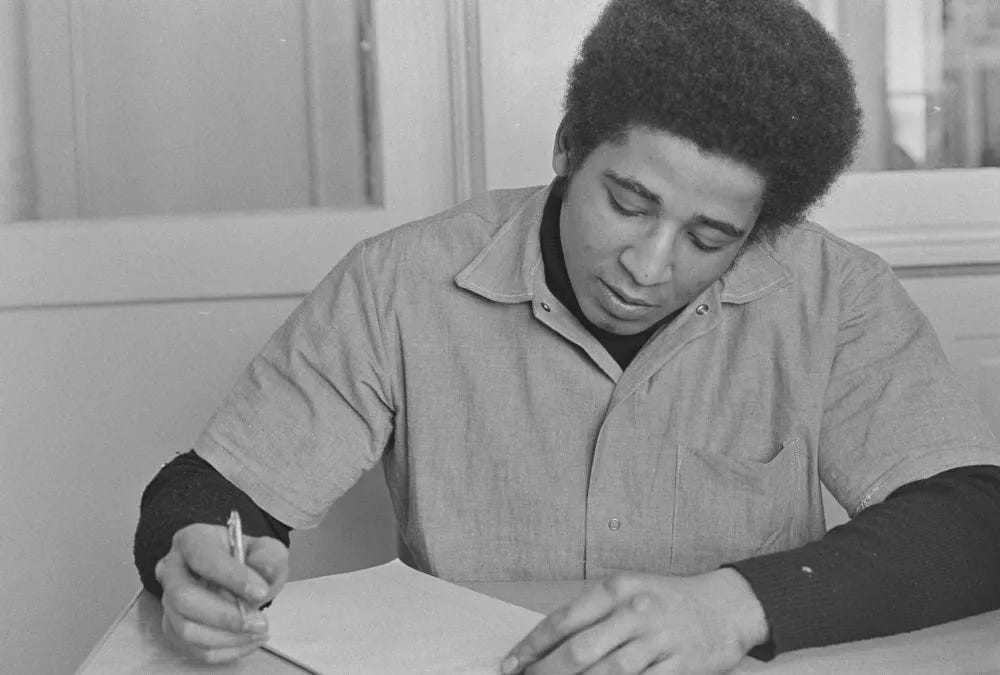
I’d heard the name George Jackson on my journey of re-education and unlearning. Today, listening to In Class With Carr in Knubia - Episode 334: Beginning Black August, George Jackson’s name finally struck the chord I needed to take the next step in my evolution towards my full Black self. The beginning of my Black August.
First, a History Lesson
I often talk about the poorly educated and today I have to count myself as one of them. I never really knew what Black August was - before it was back-to-school, and in my household always seems to be the most expensive month of the year, operating in the red not black. The difference between me and the poorly educated is the willingness to learn the truths and continuing to write history from the lion’s perspective, or as the saying goes, “Ain’t no fun when the rabbits got the gun.” Ignore the signs this administration is putting up in front of the Smithsonian - if the truth needs beautification, then it was probably a lie.
George Jackson and the Birth of Black August
George Jackson was born September 23, 1941 in Chicago and grew up in Los Angeles. At 18, he was convicted of stealing $70 from a gas station and sentenced to one year to life under California’s indeterminate sentencing law - a system that disproportionately warehoused Black men indefinitely. He spent the next 11 years incarcerated, most of it in solitary confinement.
Prison did not break George Jackson. It radicalized him. He devoured Marx, Lenin, Mao, and Fanon. He emerged as one of the sharpest revolutionary minds of his generation, corresponding with Angela Davis, mentoring fellow prisoners, and building political consciousness behind walls designed to destroy it. His letters, published in 1970 as Soledad Brother, electrified the movement outside. The world witnessed a Black man transforming captivity into clarity.
In January 1970, Jackson and two fellow prisoners - known as the Soledad Brothers - faced murder charges after a guard was killed following the shooting death of three Black inmates by another guard. The charges galvanized the movement. Angela Davis, then a young professor, became a central voice in their defense.
On August 7, 1970, Jackson’s 17-year-old brother Jonathan walked into a Marin County courthouse armed, took the judge hostage, and demanded the Soledad Brothers’ release. Jonathan Jackson died in the parking lot that day. George carried that grief inside San Quentin’s walls.
On August 21, 1971, George Jackson was killed in the yard at San Quentin under circumstances that remain disputed. Prison officials claimed he smuggled in a gun and attempted escape. Those who knew him and the evidence presented tell a different story. He was 29 years old.
Black August was born from that wound.
Prisoners inside California’s penitentiaries - men who knew Jackson, who studied under him, who loved him - created Black August in the late 1970s to honor his life and the lives of all freedom fighters who fell or were captured during the month of August. They observed it through fasting, study, physical discipline, and solidarity. No music. No recreation. Only sharpening.
August earned its weight beyond Jackson alone. Nat Turner launched his rebellion on August 21, 1831 - exactly 140 years before Jackson’s death. Marcus Garvey, the architect of Black nationalism and Pan-Africanism, was born August 17, 1887. The March on Washington, where 250,000 people demanded jobs and freedom, happened August 28, 1963. W.E.B. Du Bois died August 27, 1963 - the night before that march, as if passing the torch. August holds the bones of the movement.
The tradition spread beyond prison walls through the Malcolm X Grassroots Movement in the 1990s and reached global scale through Hip Hop. Artists like dead prez carried Black August into concert halls, community centers, and living rooms. Today organizations across the country mark the entire month with study groups, fitness challenges, cultural events, and political education - all rooted in the original prison tradition of discipline and remembrance.
Black August is a practice of becoming. It asks you to study, to fast, to train, to remember - and to carry the names of those who gave everything forward into your daily life.
My Black August
All Black Americans are political prisoners but not all of us are freedom fighters.
Toni Morrison aimed her sharpest question at white America. She asked what many refused to answer - who are you without racism? Her argument cut clean: whiteness in America constructed its identity on top of Blackness, using our oppression as the foundation of its own sense of worth and belonging. Strip racism away and that constructed self has nothing left to stand on.
Black August turns that question inward. Morrison directed it at the oppressor. Black August directs it at us - not as accusation, but as liberation. Because we have lived so long inside a system designed to define us, diminish us, and disappear us that some of that definition took root. The question becomes: who are you beneath what was done to you?
That is where Morrison’s healing challenge lands. She posed it plainly - do you want to be healed? Healed in the active sense of choosing to excavate, study, unlearn, and rise. The same discipline Black August demands in the physical and political - fasting, study, remembrance, sharpening - it demands in the spirit.
George Jackson had every reason to collapse inside those walls. He chose transformation instead. Jonathan Jackson walked into that courthouse at 17 years old carrying the full weight of his brother’s captivity. Angela Davis stood up when standing up cost everything. They answered the question. They wanted to be healed and they understood that healing looked like fighting.
My Black August begins here. With the name I finally learned. With the history I finally claimed. With the question I finally have the courage to sit with - who am I without the weight of what was done to me?
George Jackson is where my studying starts. His words, his life, his transformation inside a cage built to erase him - that is my first text. I commit to going deeper, following the thread he pulled, reading what he read, understanding what he built.
I already fast. Every day my window opens at noon and closes at 8:30 in the evening. Black August asks me to extend that discipline - to let the clarity that comes from an empty stomach also empty out the noise, the conditioning, the comfortable lies. One full day. Two. And see who shows up on the other side.
I already train three days a week. Black August asks me to train for something. George Jackson trained in a cell six feet wide. He trained for the fight - for the mental fortitude that physical discipline builds, for the dignity of a body that refuses to surrender. This August I train with intention. Every rep a declaration. Every session a remembrance.
This is my Black August. Study. Fast. Train. Remember.
Freedom fighters are not born. They are built - through exactly this kind of reckoning. And I am just getting started.
Sources & Further Reading
George Jackson
• Jackson, George. Soledad Brother: The Prison Letters of George Jackson. Coward-McCann, 1970.
• Jackson, George. Blood in My Eye. Random House, 1972.
Black August
• In Class With Carr in Knubia, Episode 334: Beginning Black August. (primary inspiration for this piece) Non-Knubians can find it on YouTube.
• Malcolm X Grassroots Movement - blackaugust.org
Toni Morrison
• Morrison, Toni. The Origin of Others. Harvard University Press, 2017. (primary source for the “who are you without racism” argument)
• Morrison, Toni. Public lectures and interviews, 1970s-2019. (healing framework, widely attributed)
Historical Figures Referenced
• Nat Turner’s rebellion: August 21, 1831
• Marcus Garvey, born August 17, 1887
• March on Washington: August 28, 1963
• W.E.B. Du Bois, died August 27, 1963
• Angela Davis - Are Prisons Obsolete? Seven Stories Press, 2003.
Thank you so much for the work and intentionality that you put into sharing this story. Necessary work!
Another great writing. I especially liked your sources for further reading. Although she wasn’t on your list, I have quite a few books from Nikki Giovanni. I once used part of her poem “The Women Gather” in an obituary for a man that I learned so much from — and loved:
We judge a man by his dreams
not alone his deeds…
we judge a man because it is not unusual
to know him through those who love him.